Order Triggers tracks instructions that wait for a condition or manage execution over time. A trigger has its own state before it creates or manages an executable child order.
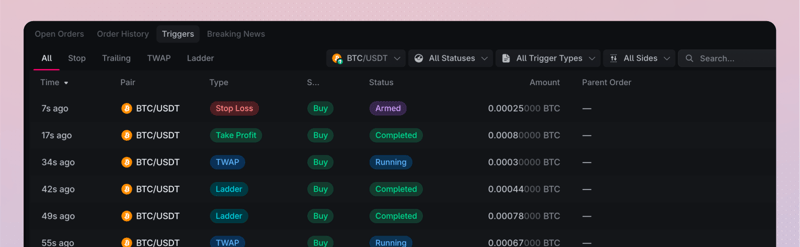
The widget organizes Stop, Trailing, TWAP, and Ladder records. Availability depends on the Pair and account.
The Stop-Loss Market, Stop-Loss Limit, Trailing Stop, TWAP, and Ladder guides explain how each instruction works.
What the widget shows
| View or field | What it means |
|---|---|
| All | Every trigger returned by the selected filters |
| Stop and Trailing | Conditional instructions tied to a price condition or trailing distance |
| TWAP | A staged instruction divided across a schedule |
| Ladder | A staged instruction distributed across price levels |
| Status and progress | Current parent state before, during, or after child execution |
The table can also show Pair, side, trigger type, amount, condition, progress, parent order, and type-specific details. Available capabilities determine which tabs and fields contain live records.
Trigger definitions and compacted state are stored and restored by server-side services. Conditions and strategies continue to be evaluated after the browser closes. Reconnect and refresh the record because persistence does not guarantee that a later child will pass admission or fill.
| Trigger family | When balance is reserved |
|---|---|
| Standalone stop, take-profit, trailing | At trigger creation |
| Standalone TWAP | When each slice is admitted |
| Standalone LINEAR Ladder | Each immediately admitted child reserves independently |
| Attached stop, take-profit, trailing | Zero at setup; the risk instruction arms after its parent fills |
Trigger, child order, and fill records
| Record | What it tracks |
|---|---|
| Trigger | Condition, configuration, progress, and parent status |
| Child order | Market or limit instruction created or managed by the trigger |
| Fill | Completed match produced by an executable child order |
An active trigger may be absent from Open Orders because it has not created a working child order yet. Follow its condition and parent status in Order Triggers.
Canceling a trigger and canceling a child order are different actions. Use only the action available for the record and state you intend to stop.
A child rejection is a terminal trigger failure, not a pause-until-balance-recovers state. The trigger releases its eligible hold and does not rearm automatically. If delivery was uncertain rather than explicitly rejected, Polyester can reconcile a retry under the same child identity instead of creating duplicate economic intent.
| Trigger family | Modification while eligible and waiting |
|---|---|
| Stop-loss or take-profit | Trigger price |
| Trailing stop | Distance, activation price, and maximum slippage |
| TWAP or Ladder | Not modifiable; cancel and recreate |
Quantity, side, strategy family, and child template cannot be changed. The trigger modification path also does not support changing a limit child's price, even when an API request schema contains that field.