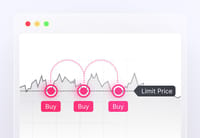
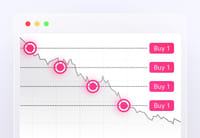
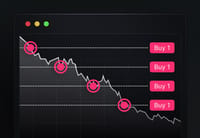
TWAP splits one target quantity into child orders released on a schedule.
What it does
A time-weighted average price strategy divides a target quantity into child orders released across a configured period.
TWAP reduces dependence on one moment of liquidity. It does not guarantee the market's TWAP benchmark, a better price, or a complete fill.
How it works
| Setting | What it controls |
|---|---|
| Total quantity | The complete amount the strategy attempts to trade |
| Duration | How long the release schedule runs |
| Slice interval | The time between child-order attempts |
| Child type | Market-IOC or supported limit-GTC behavior |
| Limit price | The execution boundary when limit children are used |
Each child must independently satisfy current Pair metadata, including quantity, price, and minimum-order rules.
TWAP creates no upfront trigger-level reservation. Each slice requests and holds the balance it needs when that child is admitted. A later slice can therefore fail even when the parent strategy was accepted.
The strategy definition and compacted state are persisted and evaluated server-side. Closing the browser does not stop its schedule, so return to Order Triggers and the child-order views to reconcile progress.
The first explicit child rejection fails the parent and stops future slices. Children admitted before that failure remain real orders: their completed fills stay final, and any still-working child must be monitored or canceled under its own lifecycle.
An uncertain transport attempt can be retried under the same slice identity. That reconciliation is different from skipping or retrying a child that admission explicitly rejected.
When to use it
- Use it when execution should be spread through time. TWAP fits a target quantity that should be divided into scheduled attempts instead of entering the market all at once.
- Avoid it when immediate completion or one price matters. Choose another order when the entire quantity should execute now or when every fill must respect one fixed limit.
Monitor the parent for schedule progress and the child orders for actual fills, rejections, and remaining exposure.
Example
Let's say Bitcoin is currently trading at 100,000 USDT. You want to buy 0.01 BTC, worth about 1,000 USDT, without submitting the entire order at once. You choose TWAP to spread the order across 10 minutes.
- TWAP divides the order into ten 0.001 BTC child orders.
- Polyester attempts one child order each minute.
- Each child passes admission and reserves balance when its turn arrives.
- If the sixth child is rejected, the remaining scheduled children stop. The first five children and any completed fills remain valid.
Result: If all ten child orders complete, you trade 0.01 BTC over the 10-minute schedule. Your average price depends on the price of each fill.
This is an example schedule. TWAP does not guarantee a benchmark price, a complete fill, or lower fees.
What to watch
- Market conditions can change between slices.
- A child can partially fill, receive no fill, or fail admission.
- A valid parent does not make every child valid.
- Canceling the parent can race with a child already being released.
- Fees apply to completed child fills, not the planned schedule.