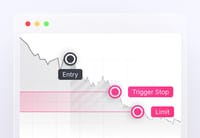
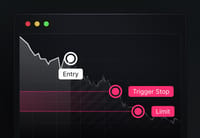
A trailing stop follows favorable price movement and activates after price reverses by the configured distance.
What it does
A trailing stop follows a favorable price extreme at a configured distance. When price reverses through the current trigger, Polyester attempts to submit the configured child order.
Unlike a fixed stop, the trigger can become more protective as the market moves favorably.
How it works
| Setting | What it controls |
|---|---|
| Trailing distance | The supported percentage or quote amount between the favorable extreme and trigger |
| Favorable extreme | The highest observed price for the current standalone trailing sell model |
| Activation price | An optional condition that starts trailing only after price reaches it |
| Slippage cap | Price protection for the market-style child after activation |
The trigger moves with a new favorable extreme. It holds its most protective level when price reverses, then activates when the condition is met.
A standalone trailing stop reserves capital when it is created. An attached trailing-risk instruction begins with zero reservation and arms after its parent fills. Both are persisted and evaluated server-side, so closing the browser does not cancel them.
When to use it
- Use it when protection should follow a favorable move. Trailing Stop fits a position that should keep gaining room while price rises, then react after a defined reversal.
- Avoid it when a fixed trigger is more appropriate. Choose a fixed stop when the exit condition should not move or when ordinary volatility could activate the selected trail too early.
Choose a distance that matches the trading plan. A smaller distance reacts sooner, while a larger distance allows more movement before activation.
Example
Let's say Bitcoin is currently trading at 100,000 USDT. You hold 0.01 BTC, worth about 1,000 USDT, and want your protection to follow the price higher without manually moving a fixed stop. You choose a Sell trailing stop with a 5% distance so it activates after a 5% reversal from the highest observed price.
- At 100,000 USDT, the trigger begins at 95,000 USDT, which is 5% below the current high.
- BTC rises to 110,000 USDT, so the trigger moves up to 104,500 USDT.
- BTC then falls to 104,500 USDT, activating the Market IOC child for 0.01 BTC.
Result: The trigger follows the market higher, then attempts to sell after price reverses by 5% from the new high.
These are example prices. The trailing distance controls activation, not the final fill price.
What to watch
- The trailing distance controls activation, not the final fill price.
- A small distance can activate during ordinary market movement.
- A large distance can allow a larger reversal before activation.
- A gap can change execution after the trigger fires.
- Balance, policy, or market state can block the child at activation.