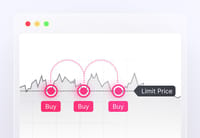
Time-in-force decides what happens to unfilled quantity, while post-only prevents taker execution.
What it does
Time-in-force controls whether unfilled quantity waits, cancels, or prevents the order from executing at all. Post-only prevents a limit order from taking liquidity.
These are instructions applied to eligible orders, not separate markets.
How it works
| Instruction | Immediate behavior | Unfilled quantity |
|---|---|---|
| GTC | Eligible quantity can fill | The remainder stays active until filled, canceled, or ended by another market or order lifecycle action |
| GTD | Eligible quantity can fill | The remainder stays active until filled, canceled, or its expiry |
| IOC | Eligible quantity fills immediately | The remainder is canceled |
| FOK | The complete quantity must fill immediately | The entire order is canceled if a full fill is unavailable |
| Post-only | A crossing order is rejected | No taker execution occurs |
Post-only works with GTC and GTD limit orders. If you select post-only while IOC or FOK is set, the Order Form switches the order to GTC and tells you. Market execution is IOC-style rather than a resting time-in-force choice.
Set an expiry with GTD
Good Til Date (GTD) keeps a limit order active until the expiry you set. Choose Good Til Date under Time In Force in the Order Form, then choose Expires:
- In 5 minutes, 30 minutes, 1 hour, 1 day, 7 days, or 30 days. A preset counts from the moment the order is placed.
- Custom. A fixed date and time, between 1 minute and 30 days from now. If it passes while you are still reviewing the order, the Order Form asks you to choose a new one.
Quantity still open at the expiry is canceled, and the order shows as expired. Completed fills stay final. GTD is offered on Limit orders only, so the limit children of stop-loss and take-profit orders use GTC, IOC, or FOK.
When to use each instruction
| Instruction | Use it when | Avoid it when |
|---|---|---|
| GTC | Unfilled quantity may wait for future liquidity | Any resting remainder would create unwanted exposure |
| GTD | Unfilled quantity may wait, but only until a chosen time | The order should stay active until you cancel it |
| IOC | Available quantity should fill now without leaving a remainder | The complete amount must fill or the order should do nothing |
| FOK | The complete amount must fill immediately or not at all | A partial fill would still be useful |
| Post-only | The order must add liquidity as a maker | Immediate execution matters or the price may cross the current market |
A limit price by itself does not guarantee maker status.
Polyester rejects a post-only order that would cross the book. It does not reprice the order to keep it resting, and post-only cannot be combined with a market order.
FOK evaluates all executable liquidity within the order's price boundary after self-trade prevention. The visible Order Book can show only part of that liquidity, so its displayed rows are useful context but not the authoritative FOK test.
GTC has no maximum lifetime or hidden expiry. Pair disablement, delisting, cancellation, or another explicit lifecycle action can still end the order, but those events are not an expiry.
Example
Let's say Bitcoin is currently trading at 100,000 USDT. You want to place a 0.01 BTC Limit buy at that price, but only 0.006 BTC is available immediately. You choose the instruction based on whether a partial fill is useful, whether the remainder can wait, or whether the entire order must fill at once. You choose post-only when your goal is to add liquidity instead of executing immediately.
Here is what each instruction does:
- GTC can fill 0.006 BTC and leave the remaining 0.004 BTC open on the Order Book.
- GTD can fill 0.006 BTC and leave the remaining 0.004 BTC open until your expiry, then cancel whatever is still open.
- IOC can fill 0.006 BTC and cancel the remaining 0.004 BTC.
- FOK cancels the entire order because the full 0.01 BTC cannot fill immediately.
- Post-only rejects the order if its 100,000 USDT limit price would immediately match a resting ask.
Result: The price and quantity stay the same, but the instruction changes what happens to the order and any unfilled quantity.
These are example prices and available quantities. FOK evaluates all eligible liquidity, which can differ from the rows currently visible in the Order Book.
What to watch
- Maker or taker treatment is determined per fill.
- A partially resting order can have both immediate and later fills when post-only is not used.
- Self-trade prevention can end an otherwise eligible match.
- A post-only rejection means the submitted price would have removed liquidity at admission.