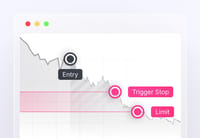
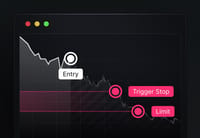
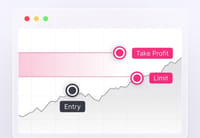
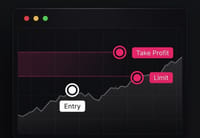
A take profit market order triggers when the price reaches your target and then attempts immediate market-style execution.
What it does
A take profit market trigger watches for a favorable price, then attempts to submit a market-style child order.
It prioritizes an execution attempt after activation rather than setting one fixed execution price.
How it works
- Watch: the selected Price Source, Last or Index, is compared with the trigger price.
- Activate: the condition is met and Polyester attempts to admit the child order.
- Execute: the market-IOC child takes eligible liquidity within its slippage cap.
- Reconcile: child orders, fills, and balances establish the final outcome.
A Sell take profit needs a trigger above the watched price and activates when the price rises to it. A Buy take profit needs a trigger below the watched price and activates when the price falls to it.
Price Source sits under Advanced in the Order Form. Last watches the last traded price and is the default. Index watches the market's index price, and the trigger waits while that price is stale. See which price a trigger watches.
The trigger and child have separate states. An accepted trigger does not prove that the later child is admitted, filled, or settled.
When to use it
- Use it when an execution attempt matters most. Take Profit Market fits a target where taking the available price matters more than one fixed execution price.
- Avoid it when a precise exit price must be protected. Choose Take Profit Limit when selling below a defined price would be worse than leaving some or all of the position open.
Confirm the active market, side, quantity, trigger price, Price Source, and slippage cap shown by the current form. To set an exit together with its entry order, attach a take-profit instead.
Example
Let's say Bitcoin is currently trading at 100,000 USDT. You hold 0.01 BTC, worth about 1,000 USDT, and want to sell if the price reaches 105,000 USDT. Because attempting to exit matters more to you than receiving one exact price, you choose Take Profit Market.
- A Last Price trade at 105,000 USDT activates the trigger.
- The best eligible bid can buy 0.006 BTC at 104,950 USDT, so the Market child fills that amount first.
- The next eligible bid can buy the remaining 0.004 BTC at 104,900 USDT, completing the order.
Result: You sell the full 0.01 BTC for 1,049.30 USDT before fees, at an average price of 104,930 USDT.
This is example liquidity. A real child order can fill partially or receive no fill when eligible bids do not exist within its slippage cap.
What to watch
- A standalone take profit reserves balance when you create it.
- A fast move can change available prices before the child is admitted.
- A slippage cap can produce a partial fill or no fill.
- Balance, policy, or market state can reject the child.
- Canceling after activation can race with execution.
- Verify the trigger on the TP/SL trigger tab, then verify fills in Order History.